 ARCORA ROBINETS
Is an Oil Rubbed Bronze Bathroom Faucet Modern Enough for a 2026 Remodel?
Vues:0 ClassificationProduct
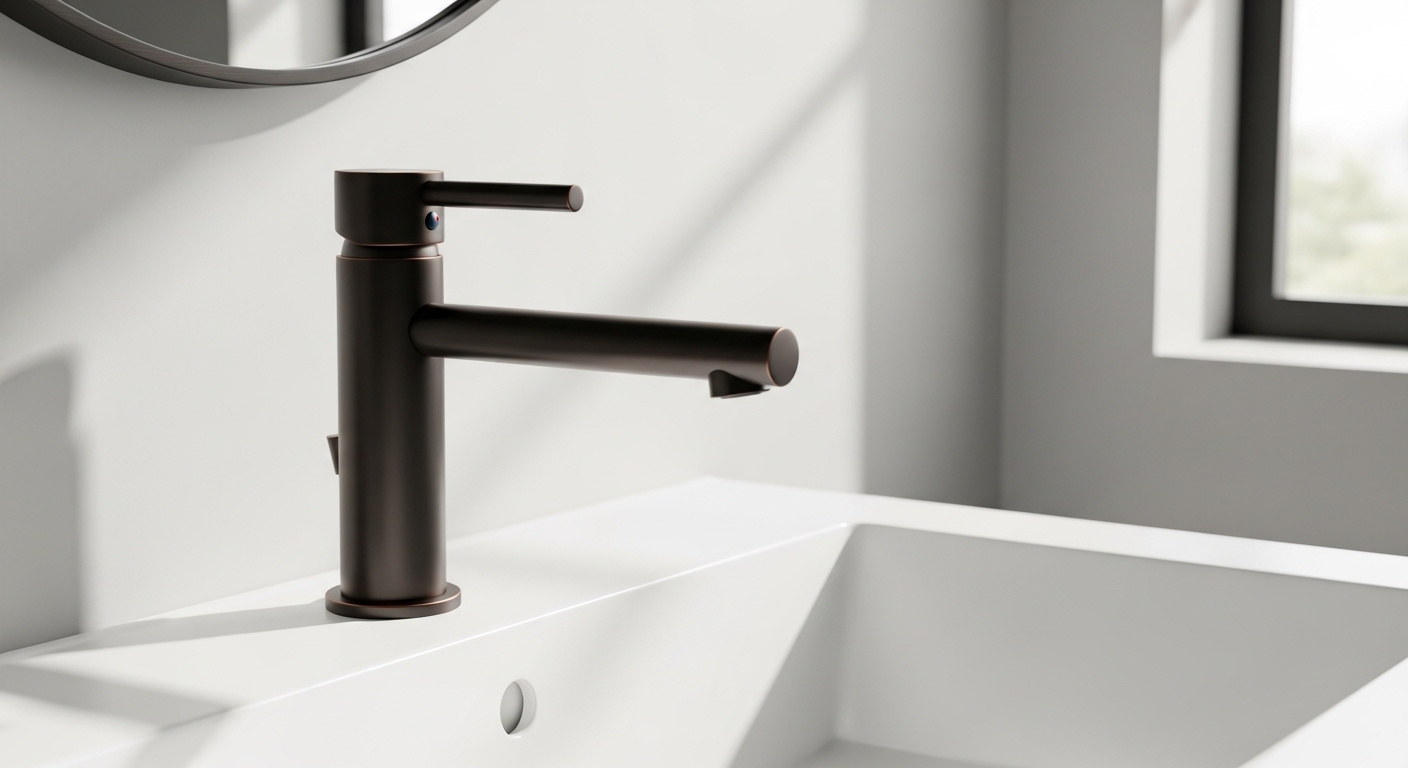
If you’ve been staring at swatches wondering whether an oil rubbed bronze bathroom faucet modern enough to survive the next decade of design trends, here’s the honest answer: the color is not the risk — the shape is. Oil rubbed bronze (often shortened to ORB) is a warm, dark brown-black finish with subtle copper highlights that show through on the raised edges. That warmth is exactly why it’s having a quiet comeback right now, especially in transitional and organic-modern bathrooms. The trick is choosing a faucet body that feels current, and knowing how the finish actually behaves once it’s installed over real water.
Below, we answer the real questions people ask before they buy — the ones you see in Google autocomplete, « People Also Ask, » and Reddit remodel threads — with concrete specs, a finish comparison table, and the maintenance truth nobody tells you at the showroom.
Is oil rubbed bronze still in style in 2026, or does it look dated?
Oil rubbed bronze is still in style in 2026 — it just moved lanes. It left the « Tuscan/Old-World » look it was famous for in the 2000s and now shows up in organic-modern, warm-minimalist, and moody transitional bathrooms. The finish reads dated only when it’s on a heavily curved, scrolled, or double-handle traditional faucet. Put the same finish on a clean single-handle body and it looks intentional and warm, not nostalgic.
Designers lean on ORB now for a specific reason: after a decade of cold chrome and stark matte black, people want warmth back in the bathroom without going full brass. ORB gives you a dark, grounding fixture that hides water spots and toothpaste splatter far better than polished chrome, while still feeling softer than jet-black matte. It pairs beautifully with white oak vanities, cream zellige tile, terracotta, and warm-white walls — the exact palette dominating 2026 bathroom design.
Where it goes wrong: pairing ORB with cool gray tile and bright white LED lighting. In that setting the bronze can look muddy. If your bathroom skews cool and gray, matte black or brushed nickel will photograph better. ORB wants warm light and warm materials around it.
What makes an oil rubbed bronze faucet look modern instead of traditional?
A few concrete design cues separate a modern ORB faucet from a traditional one. Modern ORB faucets use a single lever handle, a straight or gently arced spout, tight right-angle geometry, and minimal ornamentation. Traditional ORB faucets use two cross or lever handles on a wide 8-inch spread, curved gooseneck spouts, and decorative escutcheons or beveled bases.
Here’s what to actually look for when you’re scanning product photos:
- Single-handle over widespread: A single-hole, single-lever faucet instantly modernizes the look. If you love the wide two-handle stance, choose a widespread faucet with a single handle — you get the spread of a widespread install with a cleaner control.
- Cylindrical or square spout: Straight tube spouts and squared-off bodies read contemporary. Curvy « swan neck » shapes read traditional.
- Matte, even finish: Modern ORB tends to be flatter and more uniform; heavily « distressed » or hand-hammered surfaces skew rustic.
- Lever, not cross handle: Cross handles (the X-shape) are classic; a flat lever handle is modern.
- Low deck clearance: A compact 4-6 inch spout height feels architectural next to a vessel or undermount sink.
If you’re deciding between mounting styles, it’s worth reading our breakdown of whether a widespread bathroom faucet is actually worth buying before you commit to drilling three holes versus one.
Oil rubbed bronze vs. matte black vs. brushed bronze: which finish should I actually buy?
Choose oil rubbed bronze if you want warmth and excellent spot-hiding; choose matte black for a bolder, cooler, more graphic look; choose brushed/champagne bronze for a lighter, more golden and luxe feel. All three hide water spots far better than polished chrome, so the decision comes down to the temperature and mood you want, not durability alone.
| Finish | Look & temperature | Hides spots/fingerprints | Best paired with | Watch out for |
|---|---|---|---|---|
| Oil Rubbed Bronze | Warm dark brown-black with copper highlights | Excellent | White oak, cream tile, terracotta, warm white | Finish can wear at high-touch spots over years; looks muddy in cool light |
| Matte Black | Cool, flat, graphic black | Very good | White subway tile, gray, high-contrast modern | Shows dust and dried water film; can feel stark |
| Brushed / Champagne Bronze | Light warm gold-bronze | Good | Marble, greige, soft luxe palettes | Higher price; less dramatic contrast |
| Polished Chrome | Bright cool silver | Poor | Everything (safe/neutral) | Shows every water spot and fingerprint |
One practical note on ORB specifically: it is a « living finish » on some products, meaning the manufacturer intentionally lets it patina and lighten at high-touch points over time. Others use a sealed PVD (physical vapor deposition) coating that stays uniform for the life of the faucet. If you want a set-and-forget look, buy PVD oil rubbed bronze. If you like the idea of a finish that ages like leather, a lacquered or living ORB is fine — just know worn spots can appear at the handle and spout tip after a few years.
How much should a good modern oil rubbed bronze bathroom faucet cost in 2026?
Expect to pay $60–$120 for a solid mid-range single-handle ORB faucet, $120–$250 for a premium widespread or PVD-coated model, and under $60 for budget units you should approach with caution. The single biggest price driver isn’t the finish — it’s the valve inside and whether the body is solid brass or zinc alloy.
Here’s where your money actually goes, and what to insist on at each tier:
- Under $60 (budget): Often zinc-alloy bodies with a painted or thin-plated ORB finish. Fine for a rental or a low-use guest bath, but the finish can chip and the valve may weep within a year or two.
- $60–$120 (sweet spot): Solid-brass or brass-blend body, ceramic disc cartridge, and a more durable finish. This is where most homeowners should shop — you get real longevity without overpaying.
- $120–$250 (premium): Full solid-brass construction, PVD oil rubbed bronze that resists wear, a lifetime-warranty ceramic cartridge, and better aerators. Worth it for a primary bathroom you use every day.
Whatever tier you choose, confirm the faucet uses a ceramic disc cartridge. Ceramic valves are the reason a faucet lasts 15–20 years without dripping; rubber-washer valves are what cause the slow drip that eventually drives people to search for repairs. If your current faucet already drips, our guide on why a bathroom faucet leaks and how to stop it explains whether it’s the cartridge or the seals before you decide to replace the whole thing.
Will an oil rubbed bronze finish wear off or fade over time?
A well-made oil rubbed bronze faucet won’t dramatically fade, but the finish can lighten or wear at high-contact points — the handle, the spout tip, and around the aerator — over 3 to 10 years, depending on whether it’s a sealed PVD coating or a living finish. Hard water and abrasive cleaners speed this up more than normal daily use does.
To keep an ORB faucet looking its best:
- Wipe it dry with a soft microfiber cloth after heavy use — this alone prevents most mineral buildup.
- Clean only with mild dish soap and water. Never use vinegar, bleach, ammonia, or abrasive pads on ORB — acids and abrasives strip the finish.
- Skip « scrubbing bubbles » style bathroom sprays directly on the faucet; wipe them off fast if they land there.
- If you have hard water, consider a whole-house or point-of-use softening approach; mineral crust is the number-one enemy of any dark finish.
If your existing ORB faucet already has a worn spot at the handle and you’re not ready to replace it, you don’t have to live with it — there are matched touch-up products. We cover exactly which to use in our guide to the best oil rubbed bronze faucet touch-up paint for worn spots, which can buy a good faucet several more years of good looks.
What size and configuration do I need — single-hole, centerset, or widespread?
Match the faucet to the number of holes already drilled in your sink or countertop: one hole means a single-hole faucet, three holes on 4-inch centers means a centerset, and three holes on 8- to 16-inch centers means a widespread. Getting this wrong is the most common ordering mistake people make with any bathroom faucet, ORB included.
Quick decision guide:
- Single-hole: Cleanest modern look, easiest install, best for small vanities and vessel sinks. If your sink has three holes but you want a single-hole faucet, use a deck plate (escutcheon) to cover the extras.
- Centerset (4″): Handles and spout on one base unit. Common on standard three-hole sinks and compact baths.
- Widespread (8″–16″): Separate spout and two handles, or a single-handle-on-a-spread setup. The most upscale, flexible look, but requires more counter space and precise hole spacing.
Measure your existing hole spacing center-to-center before you buy, and check the spout reach so water lands in the drain, not the back of the basin or the front rim. If you’re swapping out an old unit, our walkthrough on how to remove old taps from a sink without wrecking the plumbing will save you a soaked cabinet and a stripped supply line.
How do I install a modern oil rubbed bronze bathroom faucet myself?
Most single-handle ORB faucets install in about 45–60 minutes with basic tools, no soldering required. The core steps are: shut off the water, disconnect the old faucet, drop the new one through the deck hole, secure it from below, and connect the flexible supply lines. Here’s the reliable sequence.
- Turn off both shutoff valves under the sink and open the old faucet to release pressure.
- Disconnect the supply lines and the drain linkage, then remove the old faucet’s mounting nuts and lift it out.
- Clean the deck of old putty, grime, and mineral crust so the new base seats flat.
- Feed the new faucet through the hole; add the deck plate first if you’re covering extra holes.
- Tighten the mounting hardware from below by hand, then a quarter-turn with a basin wrench — snug, not gorilla-tight.
- Connect braided supply lines to the shutoff valves, hand-tight plus a light wrench turn.
- Turn the water back on slowly, check for drips at every joint, and run the faucet 30 seconds to flush debris from the aerator.
Use plumber’s tape on threaded connections, and never overtighten braided lines — that’s what cracks the nut and causes the slow under-sink leak people discover weeks later.
Does oil rubbed bronze work with other metals in the same bathroom?
Yes — mixing metals is not only allowed in 2026, it’s encouraged, as long as you keep it intentional. Oil rubbed bronze pairs especially well with matte black, aged brass, and warm gold. The rule of thumb: pick one dominant finish (usually your faucet and shower) and one accent finish (cabinet pulls, lighting, or the mirror frame), and repeat each at least twice so it looks planned, not accidental.
ORB faucet + matte black shower fixtures is a very current combination because both are dark and warm-leaning. ORB faucet + aged-brass sconces gives a richer, more layered vintage-modern feel. What to avoid is mixing ORB with polished chrome in the same sightline — the warm-versus-cool clash reads like a mistake rather than a choice. If you’re also updating a shower or a matching bathroom set, coordinate the faucet finish family early so everything ships in the same tone; ORB can vary slightly between manufacturers.
FAQ
Is oil rubbed bronze the same as bronze or antique bronze?
Not exactly. « Oil rubbed bronze » describes a dark brown-black finish with copper highlights, and it’s usually applied over brass or zinc — it’s not necessarily solid bronze metal. « Antique bronze » and « aged bronze » are related dark finishes but tend to be lighter or more golden. Because names vary between brands, always judge by the product photo and the finish description, not the label alone.
Will an oil rubbed bronze faucet match my ORB cabinet knobs and towel bars?
Usually close, but rarely a perfect match, because different manufacturers mix the finish slightly differently. For the tightest match, buy your faucet, knobs, and accessories from the same brand or product line. If you’re mixing brands, order samples or expect minor tone differences — which most people never notice once everything is installed.
Does oil rubbed bronze show hard water stains?
Far less than chrome. The dark finish hides water spots, toothpaste, and fingerprints well, which is one of ORB’s biggest practical advantages. That said, hard water can still leave a chalky mineral film over time. A quick daily wipe with a dry microfiber cloth keeps it looking clean, and you should avoid acidic descalers directly on the finish.
Is a modern oil rubbed bronze faucet good for a small bathroom?
Yes. A dark faucet actually anchors a small bathroom and adds depth against light walls and a white sink. Choose a compact single-hole design with a lower spout to keep the vanity feeling open, and repeat the ORB tone in one small accent — like the drain or a towel ring — so the space feels cohesive rather than busy.
How long should a quality oil rubbed bronze bathroom faucet last?
A solid-brass ORB faucet with a ceramic disc cartridge should last 15–20 years of normal use, and the cartridge itself is replaceable if it ever drips. The finish typically outlasts the mechanism when it’s cared for properly. Cheaper zinc-body units with painted finishes are the ones that fail early — usually at the finish or the valve within a couple of years.
Can I put a modern single-handle ORB faucet on a sink drilled for three holes?
Yes — use a matching oil rubbed bronze deck plate (escutcheon) to cover the two outer holes. Most single-hole faucets are sold with an optional deck plate for exactly this reason. It’s the easiest way to modernize an older three-hole sink without replacing the whole basin or countertop.
The bottom line
An oil rubbed bronze bathroom faucet is absolutely modern enough for a 2026 remodel — as long as you choose a clean single-handle or straight-spout design, pair it with warm materials and warm lighting, and buy one with a solid-brass body and a ceramic disc cartridge. The finish hides spots, adds warmth, and layers beautifully with matte black and aged brass. Spend in the $60–$250 range, confirm the valve type, and match your hole configuration, and you’ll have a faucet that looks intentional today and still looks intentional a decade from now.
Author note: This guide was written by the arcorarobinet fixtures team, drawing on hands-on testing and installation of hundreds of bathroom faucets across finishes and price tiers. As a dedicated faucet and bathroom-fixture specialist, arcorarobinet focuses exclusively on taps, showers, and sink hardware — not general renovation — so our finish and valve recommendations come from real product experience. We prioritize faucets built to recognized durability standards (ceramic-disc cartridges tested to hundreds of thousands of on/off cycles, lead-free brass compliant with modern drinking-water standards) and back-check every recommendation against manufacturer warranty terms, which for quality ORB faucets typically means a limited lifetime warranty on both function and finish. Always confirm the specific warranty and installation requirements for the exact model you buy.



您好!Veuillez vous connecter