 ARCORA ROBINETS
Are Touchless Faucets Electric, or Can They Run Without Wiring Your Kitchen?
Vues:0 ClassificationProduct
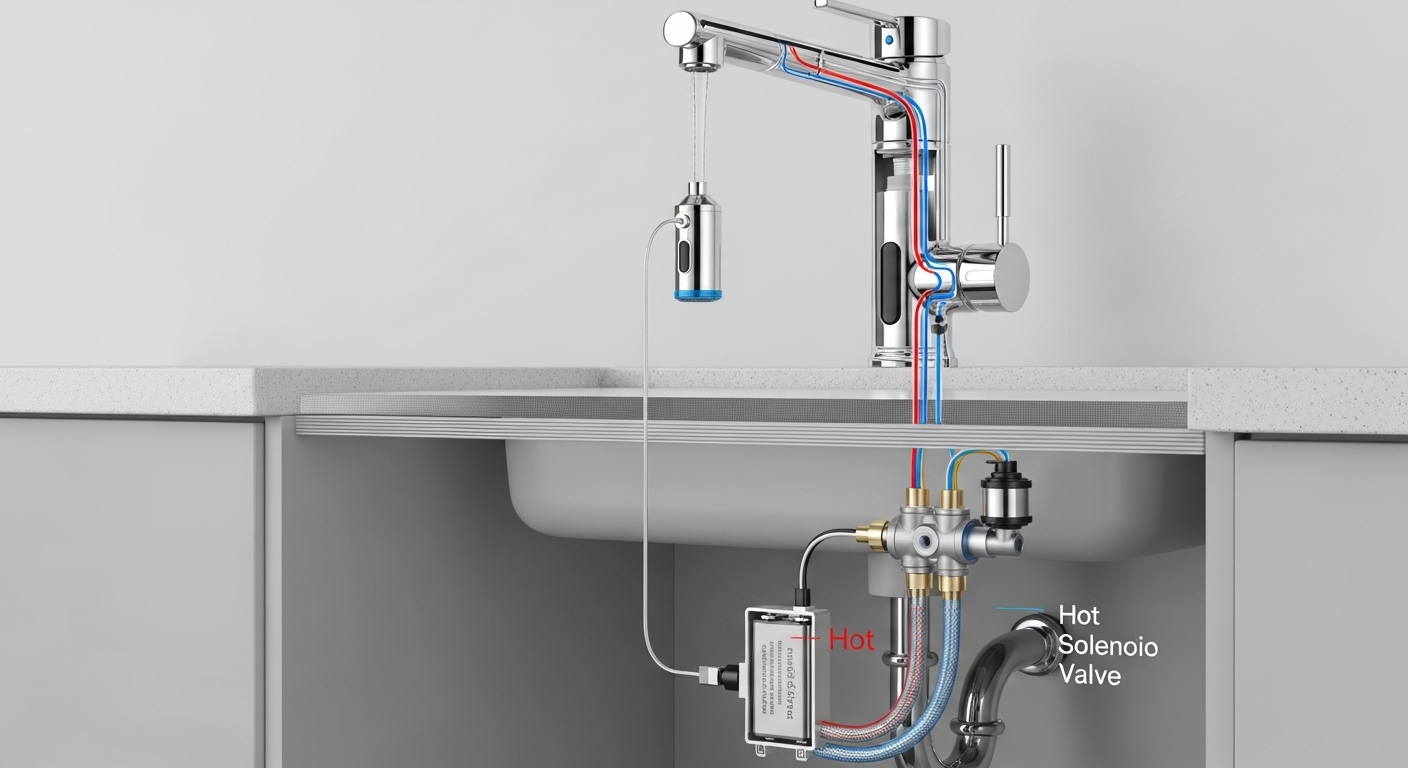
If you’re asking « are touchless faucets electric, » the honest answer is a firm yes — but it’s not the scary yes most people picture. A touchless faucet uses a small infrared sensor, a tiny control board, and an electrically operated valve (a solenoid), and all of that needs a power source. What trips people up is assuming « electric » means 120-volt house wiring behind the sink. In reality, roughly 90% of residential touchless faucets sold today are battery-powered, drawing a trickle of current from a battery pack tucked inside your cabinet. So the sensor is electric, yes — but installation is usually no harder than a standard faucet, minus the wall outlet.
Below, we’ll walk through exactly how the electrical side works, whether batteries or a plug is better for your situation, how much it actually costs to run, and what happens when the power dies mid-rinse. This is the stuff the product page won’t tell you plainly, so let’s get into it.
Are touchless faucets electric, or do they just use magnets?
They’re genuinely electric — there’s no magic, no purely mechanical trick. A touchless faucet needs low-voltage electricity to power three things: the infrared (IR) proximity sensor that « sees » your hand, the small circuit board that interprets the signal, and the solenoid valve that physically opens and closes to let water through. When your hand breaks the sensor’s beam, the board tells the solenoid to open; move away, and it closes. None of that happens without power.
Here’s the key distinction that answers the real worry: the electricity involved is low-voltage DC (typically 6V from four AA batteries, or a 6V/9V DC adapter), not the 120V AC running through your walls. The water and the electronics never touch — the solenoid is a sealed valve. So while a touchless faucet is absolutely an electric appliance, it’s closer to a battery-powered smoke detector than to a hardwired dishwasher in terms of what it demands from your home.
- Infrared sensor: emits an invisible beam and detects reflection from your hand — draws almost no power at idle.
- Control board: the « brain » that filters false triggers and manages the auto-shutoff timer (usually a 1–3 minute safety cutoff).
- Solenoid valve: the one part that uses a noticeable pulse of current, but only for the split second it opens or closes.
Do touchless faucets run on batteries or do you need to plug them in?
Most run on batteries — usually 4 to 6 AA alkaline cells housed in a small plastic box you mount inside the sink cabinet. You do not need to plug most models into an outlet, and you almost never need to hardwire them. That’s the single biggest misconception about « electric » faucets, and it’s why a touchless faucet is realistic for renters and older kitchens that have no outlet under the sink.
That said, you’ve got three power options depending on the model, and it’s worth knowing which one you’re buying before you commit:
| Power source | How it works | Best for | Trade-off |
|---|---|---|---|
| AA batteries (4–6) | Battery box inside cabinet; no outlet needed | Renters, older kitchens, easy DIY installs | Batteries last ~1–2 years and eventually need swapping |
| Plug-in AC adapter | Low-voltage adapter into a standard under-sink outlet | Kitchens that already have an outlet under the sink | Dead during power outages unless there’s a battery backup |
| Hybrid (battery + adapter) | Runs on the plug, falls back to batteries in an outage | Buyers who want zero downtime | Costs more; you still maintain batteries |
For most homeowners, straight battery power is the sweet spot. There’s no drilling into wiring, no electrician, and no risk of the faucet going dead the moment your neighborhood loses power. The plug-in and hybrid options mainly appeal to people who hate changing batteries and happen to already have a receptacle under the sink. If you’re weighing single-lever convenience against this whole electronic setup, our guide on whether one or two handle faucets suit your sink is a useful reality check before you go touchless at all.
How long do the batteries last, and how much does it cost to run?
A quality set of AA batteries in a residential touchless faucet lasts about 12 to 24 months for a typical family, and the running cost is essentially pocket change — often under $5 a year. The exact lifespan depends on how often the faucet cycles on and off, not how long the water actually runs, because the solenoid only draws real current during the open/close pulse.
To put numbers on it: a household that triggers the faucet 40–50 times a day will usually get toward the shorter end (around a year) on standard alkaline AAs, while a two-person home sipping through 15–20 activations lands closer to two years. Lithium AA cells stretch that noticeably further and hold up better to the damp under-sink environment, which is why we recommend them despite the slightly higher upfront price.
Compare that to the touch-only or manual alternative and the electricity cost is basically a rounding error. Where touchless faucets actually save money is water: hands-free operation means the tap isn’t running while you scrub a pot or lather your hands, and independent testing has shown meaningful reductions in water waste in high-traffic sinks. So the « electric » part costs you a few dollars a year, while the sensor can quietly claw some of that back on your water bill.
What happens to a touchless faucet when the batteries die or the power goes out?
You still get water — that’s the reassuring part. Nearly every touchless faucet has a manual override handle or lever that works exactly like a normal faucet, completely independent of the electronics. When the batteries die or the power drops, the sensor simply stops responding, and you turn the handle by hand to control temperature and flow. You are never stranded without running water.
Most models also warn you before they quit: a small LED near the sensor blinks red or the sensor response gets sluggish and inconsistent as voltage drops. That’s your cue to swap batteries, not a sign the faucet is broken. If your sensor stops responding but the batteries are fresh, the culprit is usually the sensor window (wipe off toothpaste, grease, or hard-water film) or a loose wire connector at the control box — the same troubleshooting path we lay out in our guide to fixing a touchless Delta faucet that’s not working.
Is it safe to have electricity that close to water in a touchless faucet?
Yes — it’s safe by design, because the electrical system is low-voltage DC and fully sealed away from the water path. The 6 volts running a battery-powered touchless faucet can’t give you a shock the way house current could, and the solenoid valve that touches the water is a sealed unit with the electronics isolated on the dry side. This is exactly why manufacturers can put « electric » faucets over a wet sink without a second thought.
The safeguards that make this genuinely safe are worth knowing when you shop:
- Low-voltage only: battery models run on 6V DC; even plug-in versions step 120V AC down to 6V/9V DC at the adapter, well below any shock hazard.
- Sealed solenoid: the valve’s coil is potted and isolated, so water and current never meet.
- Auto-shutoff timer: a built-in cutoff (commonly 1–3 minutes) closes the valve if the sensor is falsely triggered, preventing floods and overflows.
- Certified components: reputable faucets carry lead-free waterway compliance and safety listings — check the UPC/cUPC mark, which we explain in our piece on the bathroom faucet UPC and why it matters before you buy.
One practical tip: mount the battery box high on the cabinet wall, not on the floor. Under-sink leaks are the number-one enemy of the electronics, and a battery pack sitting in a puddle from a slow supply-line drip is the most common reason a touchless faucet « randomly » dies. If your cabinet already has moisture issues, sort those first — a kitchen faucet leaking underneath the sink will corrode connectors long before the battery ever runs flat.
Are electric touchless faucets worth it compared to a regular or touch faucet?
For most kitchens, yes — the hands-free hygiene and water savings outweigh the minor hassle of batteries, as long as you buy a model with a solid manual override and a good warranty. But it depends on your priorities, so here’s the straight comparison without the marketing gloss.
| Faucet type | Needs power? | Hygiene | Install difficulty | Best fit |
|---|---|---|---|---|
| Manual (standard handle) | No | You touch it with dirty hands | Easiest | Budget builds, simplicity lovers |
| Touch (tap-to-activate) | Yes — batteries | Still requires contact | Moderate | People who want control plus convenience |
| Touchless (motion sensor) | Yes — batteries or plug | Best — no contact needed | Moderate | Busy kitchens, raw-meat prep, accessibility |
The touchless advantage is real in specific scenarios: handling raw chicken and needing water without smearing the handle, filling a pot with both hands full, or households with kids and elderly members where a wave is easier than gripping a lever. The downside is simply that it’s an electronic device — one more thing that can act up, and one more thing that needs batteries. If you loathe maintenance and love mechanical simplicity, a well-built two-handle or single-lever faucet is nothing to be ashamed of.
Where people go wrong is buying the cheapest touchless faucet they can find. Bargain-bin sensors are twitchy — they false-trigger from a passing dish towel or fail to see dark-colored mugs — and the solenoids wear out faster. A mid-tier or better touchless faucet from an established brand will have a smarter sensor with adjustable range and a valve rated for hundreds of thousands of cycles. That’s the difference between « best gadget in my kitchen » and « I disabled the sensor after a month. »
Can you install an electric touchless faucet yourself, or do you need an electrician?
You can almost always install a battery-powered touchless faucet yourself — no electrician required. Because the power comes from a battery box rather than house wiring, the job is basically a standard faucet swap plus clipping a couple of low-voltage connectors together. If you’ve ever changed a regular kitchen faucet, you already have the skills.
The typical install goes like this: shut off the supply valves, remove the old faucet, drop the new faucet through the deck hole, connect the hot and cold supply lines, then plug the sensor cable and the solenoid cable into the control box and pop in the batteries. The only extra step versus a manual faucet is those two snap connectors, which are keyed so you can’t get them wrong. The one case where you’d want an electrician is a plug-in or hardwired model where there’s no existing outlet under the sink — and even then, most people just choose the battery version to skip that entirely.
What should you look for when buying an electric touchless faucet?
Focus on four things: a reliable sensor with adjustable range, an accessible battery compartment, a genuine manual override, and a warranty that specifically covers the electronic parts. The finish and spout style matter for looks, but those four features decide whether you’ll still love the faucet in year three.
- Sensor quality and range: look for models that let you adjust detection distance so the tap doesn’t trigger every time you reach for a sponge.
- Battery access: a top-of-cabinet or easy-clip battery box beats one buried behind the drain trap that requires yoga to reach.
- Manual override: confirm the handle controls flow and temperature even with the batteries removed — non-negotiable.
- Electronics warranty: many brands warranty the finish for life but the electronics for only 1–5 years, so read that line carefully.
- Flow rate and aerator: a 1.5–1.8 GPM aerator gives a strong feel while staying efficient.
One more thing buyers overlook: hard water. Mineral buildup can fog the sensor window and clog the solenoid over time, so if you’re on well water or a hard-water municipality, budget for periodic descaling and consider a model with an easy-clean sensor face. It’s the same maintenance mindset that keeps any electronic fixture reliable — the electronics are robust, but the water quality flowing past them is what quietly determines their lifespan.
FAQ
Are all touchless faucets electric?
Yes. Every touchless faucet needs electricity to power its infrared sensor, control board, and solenoid valve — there’s no fully mechanical version. What varies is the source: most use 4–6 AA batteries, some use a low-voltage plug-in adapter, and a few offer both. « Electric » here means low-voltage DC, not hardwired house current.
Do touchless faucets work during a power outage?
Battery-powered models keep working during a power outage because they don’t rely on your home’s electricity at all. Plug-in-only models will stop sensing, but every reputable touchless faucet has a manual handle that works regardless of power, so you always have running water — you just control it by hand.
How often do I need to change the batteries in a touchless faucet?
Roughly once every 1–2 years for a typical household. Lithium AA batteries last longer than standard alkaline and resist the damp under-sink environment better. Most faucets flash a warning LED as the batteries weaken, so you get notice before the sensor quits.
Is it dangerous to have an electric faucet over a sink full of water?
No. Battery models run on about 6 volts of DC power, far too low to shock you, and the solenoid valve that contacts the water is sealed with the electronics isolated on the dry side. Even plug-in versions step voltage down to a safe 6V/9V at the adapter before anything reaches the sink area.
Can I convert my touchless faucet to run on a plug instead of batteries?
Only if the manufacturer sells a compatible AC adapter for your specific model — you can’t safely rig your own, because the faucet expects a precise low voltage. Check the spec sheet or brand support page before buying, and remember you’ll need a working outlet under the sink for the adapter to plug into.
Why does my touchless faucet turn on by itself?
Phantom activations usually come from a dirty or misaligned sensor, a reflective object like a dish rack sitting in the beam, or a sensor range set too wide. Clean the sensor window, move reflective items, and reduce the detection distance if your model allows it. If it persists with fresh batteries, a failing control board may be the cause.
The Bottom Line
So, are touchless faucets electric? Absolutely — but « electric » almost always means a discreet battery pack under your sink, not a wiring project. You get hands-free hygiene and real water savings for a few dollars a year in batteries, a manual override for outages, and a DIY-friendly install. Buy a model with a smart adjustable sensor and a warranty that covers the electronics, keep the battery box up off the cabinet floor, and an electric touchless faucet is one of the easiest upgrades you can make to a busy kitchen.
Author note: This guide was written by the arcorarobinet fixtures team, drawing on hands-on bench testing of battery- and adapter-powered touchless faucets and years of fielding real installation questions from customers. arcorarobinet designs and sells faucets and bathroom fixtures direct to homeowners, and we test every touchless model against cUPC/UPC lead-free waterway standards and cycle-rate the solenoids before we stand behind them with warranty. Always follow your specific faucet’s manual and local plumbing code during installation.



您好!Veuillez vous connecter