 ARCORA ROBINETS
Where Can You Buy a Good Pot Filler Faucet in the Philippines — And Is It Worth It?
Vues:0 ClassificationProduct
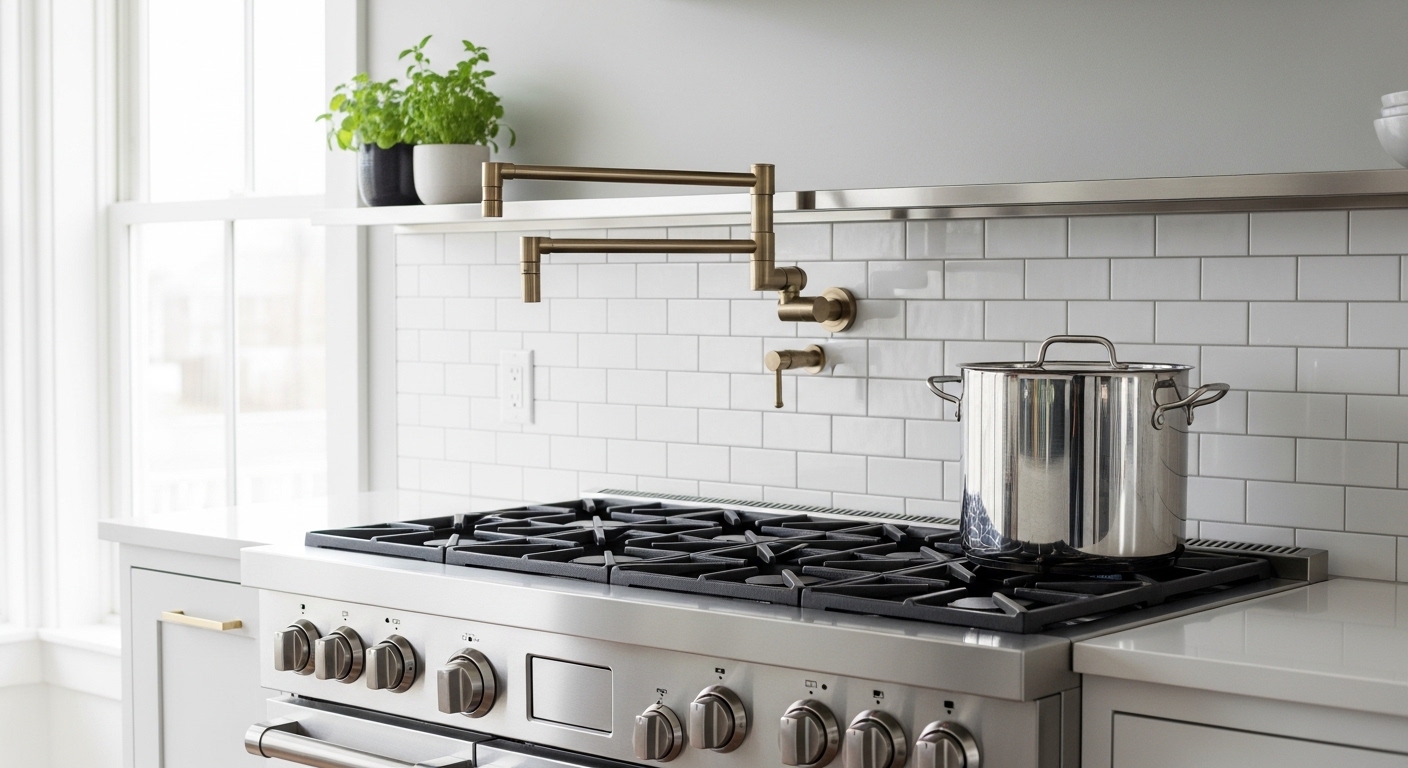
If you’ve been searching for a pot filler faucet philippines buyers can actually rely on, here’s the honest answer: yes, they’re available here — through specialty fixture retailers, online marketplaces like Lazada and Shopee, and imported-brand showrooms in Metro Manila, Cebu, and Davao — but the quality gap between a ₱1,800 no-name unit and a ₱12,000 solid-brass one is enormous. A pot filler is a cold-water tap mounted on the wall behind or beside your stove, on a jointed arm that swings out over a pot so you fill it right where you cook. In a Filipino kitchen where sinigang, nilaga, and rice for a big family go in large stockpots, that convenience is real. But because our tap water is often hard and our climate is punishingly humid, the build quality matters more here than it does in a dry-climate kitchen abroad.
This guide breaks down what a pot filler actually does, what it costs in the Philippine market, how to choose one that won’t corrode or leak in two years, and how to have it installed correctly — because a pot filler is only as good as the water line and mounting behind it.
What exactly is a pot filler faucet, and do Filipino kitchens really need one?
A pot filler is a dedicated cold-water faucet installed at your cooktop so you can fill heavy pots without carrying them across the kitchen. It’s not a replacement for your sink faucet — it’s a second, purpose-built tap that swings out on a double-jointed articulated arm, reaches over the burner, and folds flat against the wall when you’re done.
Do you need one? Honestly, no — a kitchen works fine without it. But if any of these describe you, it earns its keep fast:
- You regularly cook for a large or extended family and fill big stockpots (5 liters or more) with water.
- You run a small food business, carinderia, or catering setup out of your home kitchen.
- You have wrist, back, or shoulder issues that make carrying a full pot of water genuinely risky.
- Your sink is far from your stove, or on a different counter run entirely.
The core benefit is simple physics: a full 8-liter pot weighs about 8 kilos of water alone. Moving that from a sink to a burner, several times a day, is exactly the kind of small strain that adds up. A pot filler lets the water come to the pot instead. For a deeper look at whether the classic styling holds up, we’ve also covered whether a vintage pot filler faucet is worth installing over your stove in 2026 — the mechanics are the same, the finish and aesthetic differ.
How much does a pot filler faucet cost in the Philippines in 2026?
Expect to pay between ₱1,800 and ₱25,000+, and the price bracket tells you almost everything about what’s inside. The cheapest units are zinc-alloy or thin stainless with rubber-washer valves that fail early; the mid and upper range are solid brass with ceramic-disc cartridges that last a decade or more. Here’s a realistic breakdown of the market as we see it across local retailers and online sellers.
| Price band (PHP) | Typical build | Valve type | Best for | What to watch |
|---|---|---|---|---|
| ₱1,800 – ₱4,000 | Zinc alloy / thin stainless | Rubber washer or cheap cartridge | Light, occasional use / renters | Corrosion, drips, loose joints within 1–2 years |
| ₱4,500 – ₱9,000 | Stainless 304 or brass core | Ceramic-disc cartridge | Everyday family cooking | Verify it’s truly solid, not brass-plated zinc |
| ₱10,000 – ₱18,000 | Solid brass, heavy joints | Dual ceramic-disc valves | Heavy daily use / home business | Confirm warranty and local parts support |
| ₱18,000 – ₱25,000+ | Premium imported brass, PVD finish | Dual ceramic-disc, aerated | High-end remodels, showrooms | Longest lead times; specify finish carefully |
The sweet spot for most Filipino households is the ₱4,500–₱9,000 band — solid enough to survive our water, cheap enough to justify. Below ₱4,000 you’re gambling on materials that our humidity and chlorinated tap water will chew through. The same « solid brass and ceramic valve » rule we recommend for the best kitchen faucets with ceramic valves applies doubly here, because a pot filler sits in the hottest, most humid, greasiest corner of your kitchen.
Wall-mounted or deck-mounted — which pot filler is right for my stove?
For almost everyone, a wall-mounted pot filler is the right choice — it puts the spout directly over the burners and keeps your counter clear. A deck-mounted (countertop) pot filler only makes sense if you physically can’t run a water line inside the wall behind your stove, which is common in older Philippine homes and condos with solid concrete walls.
Here’s how to decide:
- Wall-mounted: Best reach, cleanest look, folds flat against the backsplash. Requires a cold-water line stubbed out of the wall at the right height (usually 20–25 cm above the cooktop surface). Ideal in new builds or renovations where the wall is open.
- Deck-mounted: Mounts on the counter beside the stove. Easier to add to an existing kitchen because the water line comes up from below through the countertop, not out of a concrete wall. Slightly shorter effective reach.
If your kitchen has a concrete or CHB (concrete hollow block) wall — very typical here — running a recessed water line means chipping a channel and re-plastering, which is doable but adds labor cost. A deck-mount sidesteps that entirely. This is the same wall-versus-deck tradeoff professionals weigh when specifying a wall mount faucet for a commercial project, and the plumbing logic carries straight over to a home pot filler.
Will a pot filler survive Philippine tap water and humidity?
Only if you buy the right materials — solid brass or genuine 304 stainless with a ceramic-disc valve. Cheap zinc-alloy pot fillers corrode from the inside out in our climate, and rubber-washer valves stiffen and leak because of mineral scale from hard water. That’s the whole story: material choice decides lifespan.
Philippine tap water quality varies a lot by area. Parts of Metro Manila, Cavite, Laguna, and Cebu have noticeably hard water (high calcium and magnesium), which leaves white scale on aerators and clogs valves over time. Add year-round humidity and salt-laden coastal air, and you have an environment that punishes weak fixtures. Three things protect you:
- Solid brass or 304 stainless body — brass naturally resists corrosion and scale; avoid anything vaguely described as « alloy » or « metal. »
- Ceramic-disc cartridge — these seal with polished ceramic plates instead of rubber, so mineral scale doesn’t destroy them. They’re the reason a good faucet can go 10+ years drip-free.
- PVD or quality electroplated finish — physical vapor deposition finishes resist the fading and pitting that our humid air causes on cheaper coatings.
If your area has genuinely hard water, wipe the aerator monthly and consider a whole-line or point-of-use filter. We break down where filtration actually helps in our guide on whether you really need a faucet water filter — the mineral-scale problem it solves is exactly what shortens a pot filler’s life.
How do you install a pot filler faucet — can a homeowner DIY it?
The faucet itself is simple to attach, but getting a cold-water line to the wall behind your stove is real plumbing — most Filipino homeowners should hire a licensed plumber for that part. If a capped cold-water stub-out already exists behind the cooktop, a handy DIYer can mount the faucet in under an hour. If it doesn’t, you’re into tapping a supply line and chasing the wall, which is a pro job.
Here’s the realistic sequence:
- Plan the water line. A pot filler needs only a cold supply. A plumber taps your nearest cold line and runs it to a stub-out behind the stove, about 20–25 cm above the cooktop, centered over the burners.
- Pressure-test the line. Before closing the wall, the line should be tested for leaks. This is non-negotiable — a leak behind a tiled wall is expensive to find later.
- Mount the faucet. Thread the faucet onto the stub-out with PTFE (plumber’s) tape on the connection, tighten firmly but don’t over-torque, and check it sits level and folds flat.
- Test under pressure. Turn the supply on, run the faucet fully open, and check every joint for weeping. Swing the arm through its full range while the water runs.
One tip that saves headaches: install a small shut-off valve on the pot filler’s supply line inside an accessible spot, so you can isolate it for repairs without killing water to the whole kitchen. And before you disturb any existing plumbing, it’s worth knowing how to remove old taps from a sink without wrecking the plumbing underneath — the same care with corroded fittings and shut-offs applies when you’re teeing into an old line for a pot filler.
What features actually matter on a pot filler — and which are just marketing?
The features worth paying for are the double-jointed arm, dual shut-off valves, and a solid-brass body; most other « premium » add-ons are cosmetic. Here’s how to separate substance from sales talk.
Worth it:
- Double-jointed (articulated) arm — two hinge points let the spout reach every burner and fold completely flat. A single-joint arm is noticeably less useful.
- Two shut-off valves — one at the wall base and one at the spout. The spout valve lets you position the arm, then turn water on exactly over the pot, so you don’t splash reaching across.
- Solid brass construction and ceramic valves — the durability core, as covered above.
- Aerator on the spout — reduces splashing when filling, and is easy to unscrew and de-scale.
Mostly marketing:
- « Antibacterial » coatings — negligible real-world benefit for a cold-water fill tap.
- Exotic finishes at a big premium — matte black and brushed gold look great, but make sure the finish is PVD, not a thin coating that will wear. Trend-chasing without durability is a waste; our rundown of real kitchen tap trends 2026 buyers should actually care about separates lasting finishes from fads.
- Very long spout reach on a small kitchen — measure your burner layout; an over-long arm just gets in the way.
Where should you actually buy a pot filler in the Philippines?
Buy from a seller that offers a written warranty and locally available replacement cartridges — that single filter eliminates most of the junk. Your realistic options here are specialty fixture showrooms, established hardware chains, and online marketplaces, each with tradeoffs.
| Channel | Pros | Cons |
|---|---|---|
| Specialty fixture showrooms (Metro Manila, Cebu, Davao) | See and handle the unit, expert advice, real warranties, parts support | Higher price, limited locations |
| Hardware chains (Wilcon, CW Home Depot, etc.) | Widely accessible, some brand names, returns policy | Limited pot-filler selection, staff may not specialize |
| Online (Lazada, Shopee, brand sites) | Widest choice, easy price comparison, delivery nationwide | Hard to verify materials; many zinc units mislabeled « brass » |
If you buy online, read the specs literally: « stainless steel » and « solid brass » are meaningful; « premium alloy, » « metal, » or a suspiciously light shipping weight are red flags. Message the seller and ask two questions — « Is the body solid brass or plated? » and « Does it use a ceramic-disc valve, and can I buy a replacement cartridge? » A seller who can’t answer clearly is not the one to buy from.
Author’s note & why you can trust this guide
This guide was written by the product team at arcorarobinet, a specialist faucet and bathroom-fixtures brand. We spend our days sourcing, testing, and troubleshooting kitchen and bath fixtures, and we evaluate pot fillers the same way we assess any tap: valve endurance, body material, joint play after repeated cycling, and finish resistance to humidity and scale. We favor fixtures whose valves and bodies meet recognized durability benchmarks — look for ceramic cartridges rated for hundreds of thousands of open-close cycles, and choose a supplier that backs the faucet with a real warranty (5 years or more on the body and finish is a good sign). A pot filler is a lifetime-of-the-kitchen fixture, so buy it once and buy it right.
FAQ
Is a pot filler faucet worth it for a normal Filipino household?
It’s worth it if you frequently fill large pots — big-batch soups, stews, and rice for an extended family, or a home food business. If you rarely cook with pots bigger than a few liters, a good sink faucet does the job and a pot filler is a luxury, not a necessity.
Do you connect a pot filler to hot or cold water?
Cold water only. A pot filler is a single cold-supply tap by design — you heat the water on the stove, so there’s no reason to run a hot line to it. This also makes installation simpler and cheaper, since only one supply line is needed.
What’s a reasonable price for a durable pot filler in the Philippines?
Budget ₱4,500 to ₱9,000 for a solid, everyday unit with a brass or 304-stainless body and a ceramic-disc valve. Heavy-use or premium imported models run ₱10,000 to ₱25,000+. Below ₱4,000, you’re usually buying zinc alloy that our humidity and hard water will degrade within a couple of years.
Can I install a pot filler in a condo or a house with concrete walls?
Yes, but it takes more work. Concrete and CHB walls need a channel chipped and re-plastered to recess the water line, which adds labor. If that’s not practical, choose a deck-mounted pot filler that sits on the counter beside the stove and takes its supply from below — no wall chasing required.
How do I keep a pot filler from leaking or scaling up over time?
Buy a ceramic-disc valve, not a rubber-washer one, and unscrew the aerator to de-scale it monthly if you have hard water. Install a shut-off valve on the supply line so you can service the faucet easily, and don’t over-tighten the arm joints, which wears the internal seals. These habits keep a quality pot filler drip-free for a decade or more.
Will a pot filler add much to my water bill?
No. A pot filler uses the same water you’d draw from the sink anyway — you’re just getting it at the stove instead. It doesn’t consume extra water; it only changes where the water comes out.



您好!Veuillez vous connecter